From correlation to causal interpretation
Department of Computer Science
University of the Philippines Cebu
"Every coefficient tells a story about cause and effect."
— George E.P. Box, 1976
This week: how to make regression useful for explaining and predicting in the Philippine context.
The OLS equation, coefficient interpretation, and the meaning of “holding all else constant.”
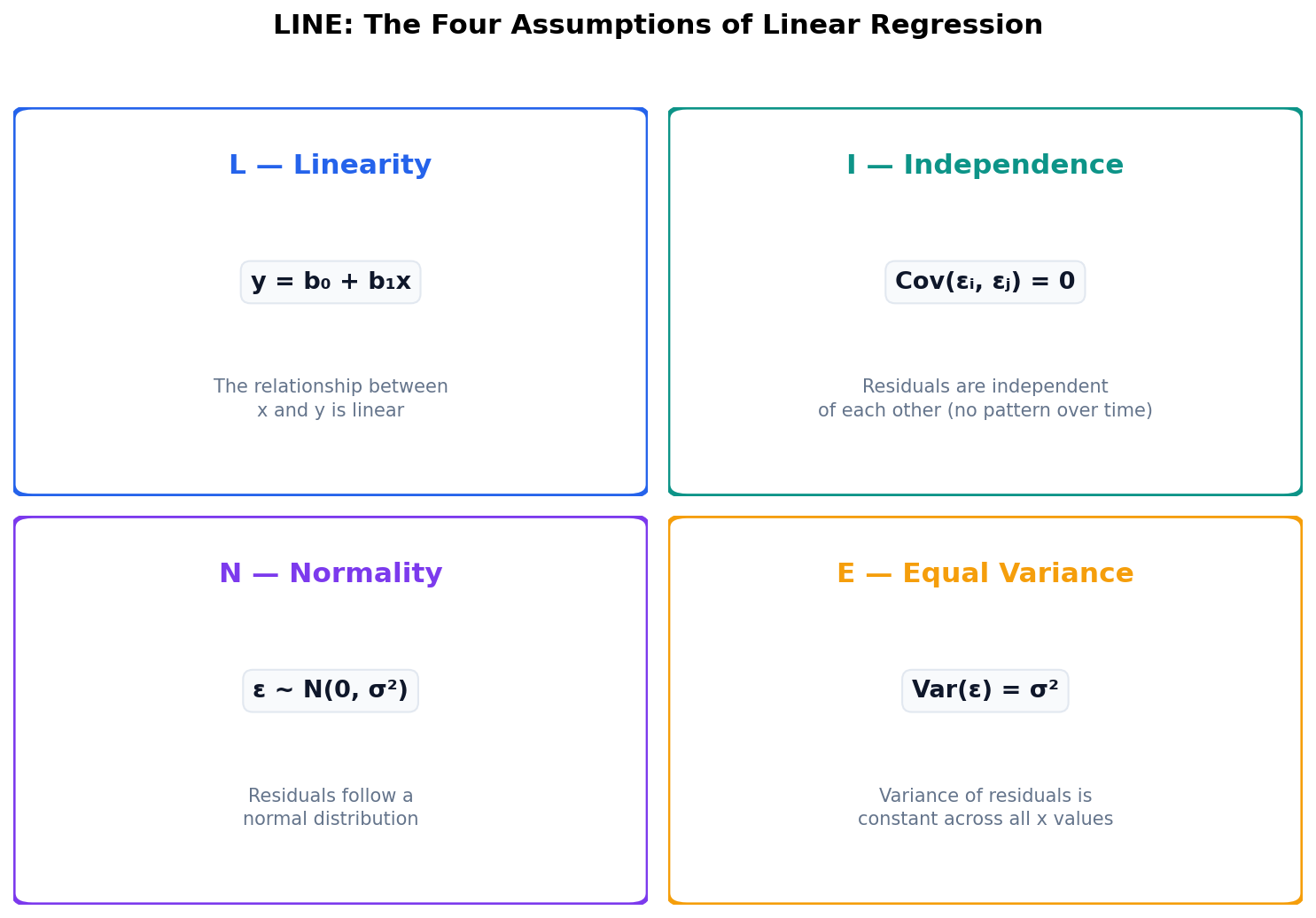
LINE assumptions, residual plots, VIF, and when to trust your model’s output.
Regional poverty model using PSA data: literacy, GDP, and urbanization as predictors.
By the end of this session you will be able to build, diagnose, and interpret a multiple regression model for any Philippine dataset.
Builds on: CMSC 173 ML + Weeks 5–6
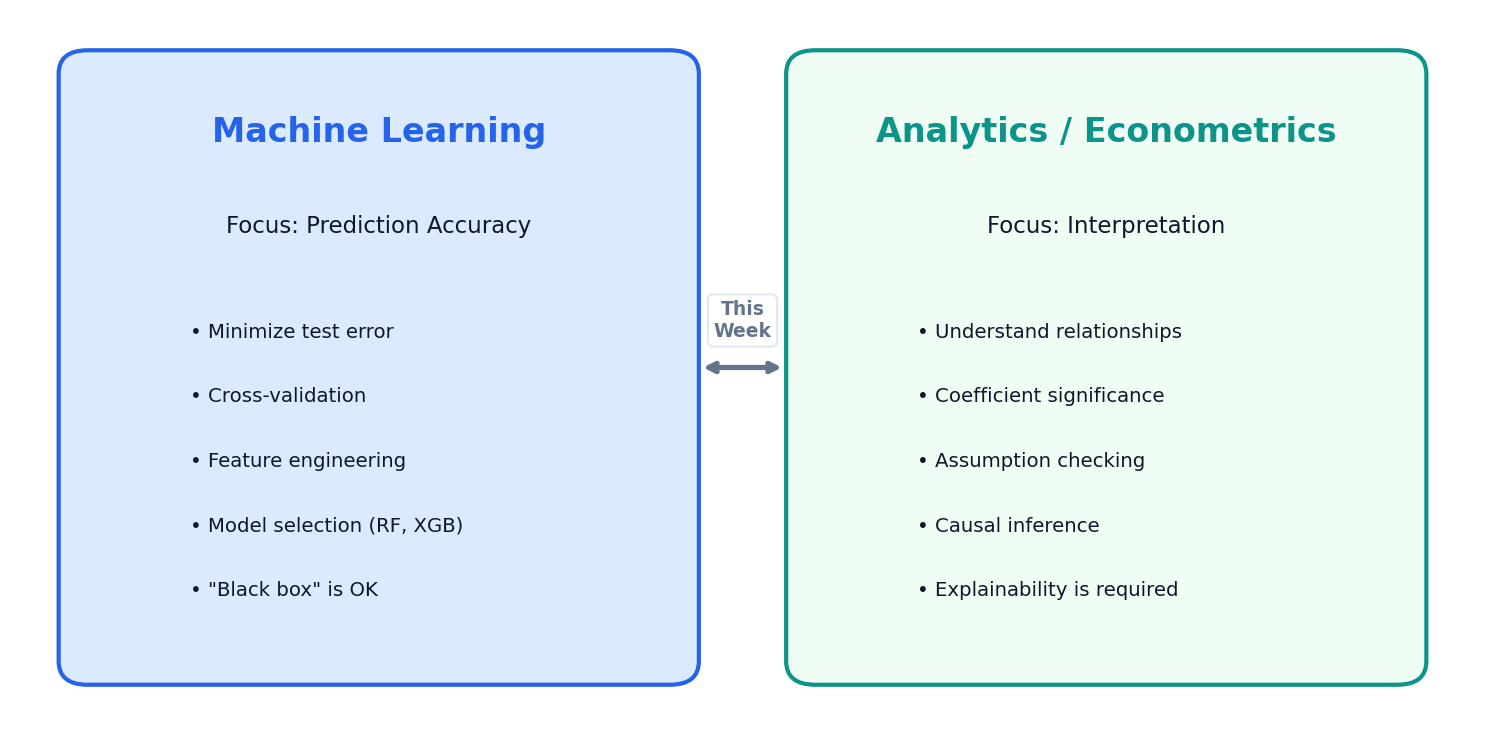
Regression in analytics is about explanation — not just prediction. The coefficients are the story.
Interpretation of coefficients, assumption checking, and communicating results to stakeholders.
You already know how regression works mechanically — now learn to read the story in the coefficients.
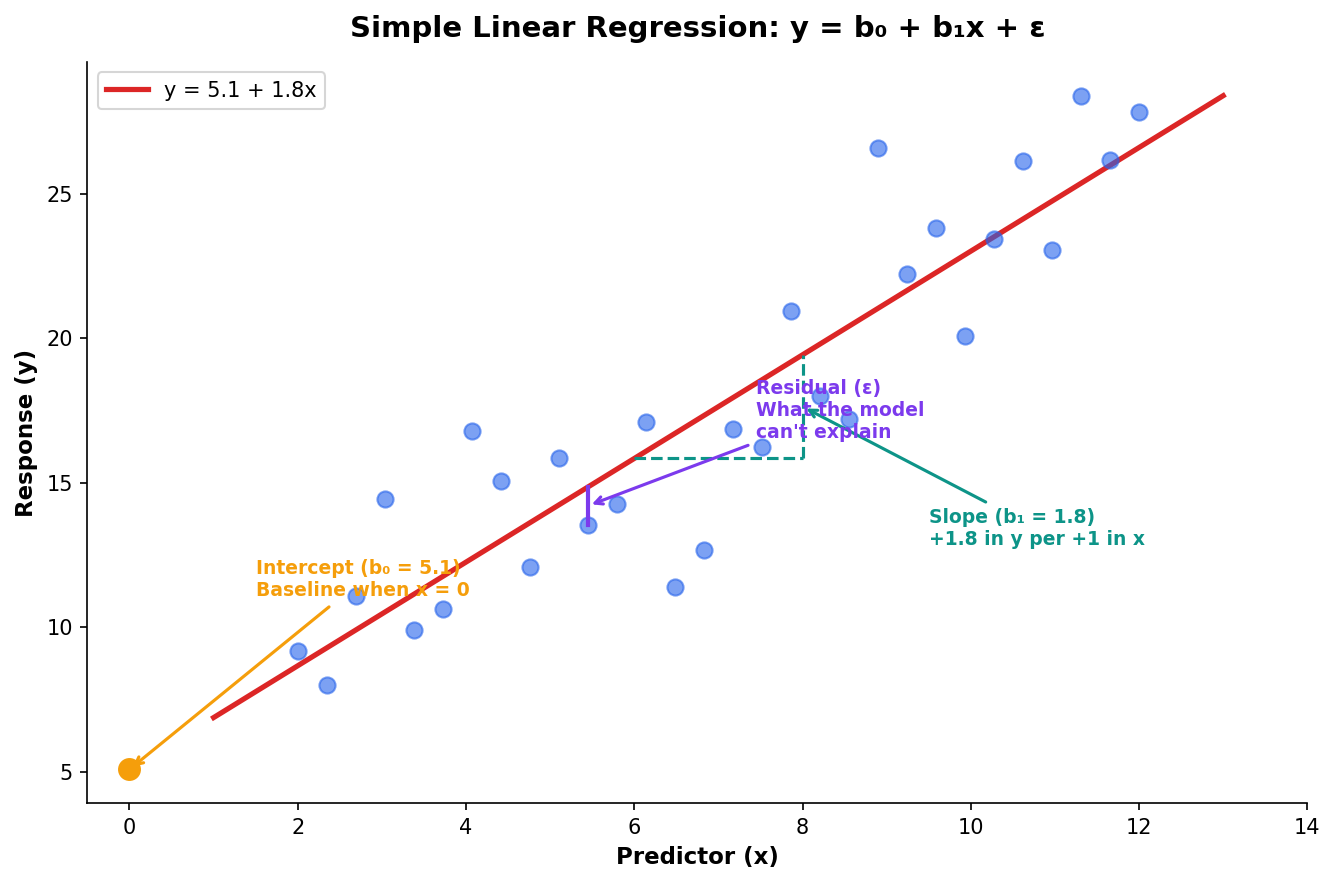
Every regression equation has three characters: the baseline (b₀), the effects (b₁, b₂…), and the unexplained (ε). Together they tell a story about what drives the outcome.
The predicted value when all predictors are zero — often a theoretical baseline.
The change in y for a 1-unit increase in x, holding everything else constant.
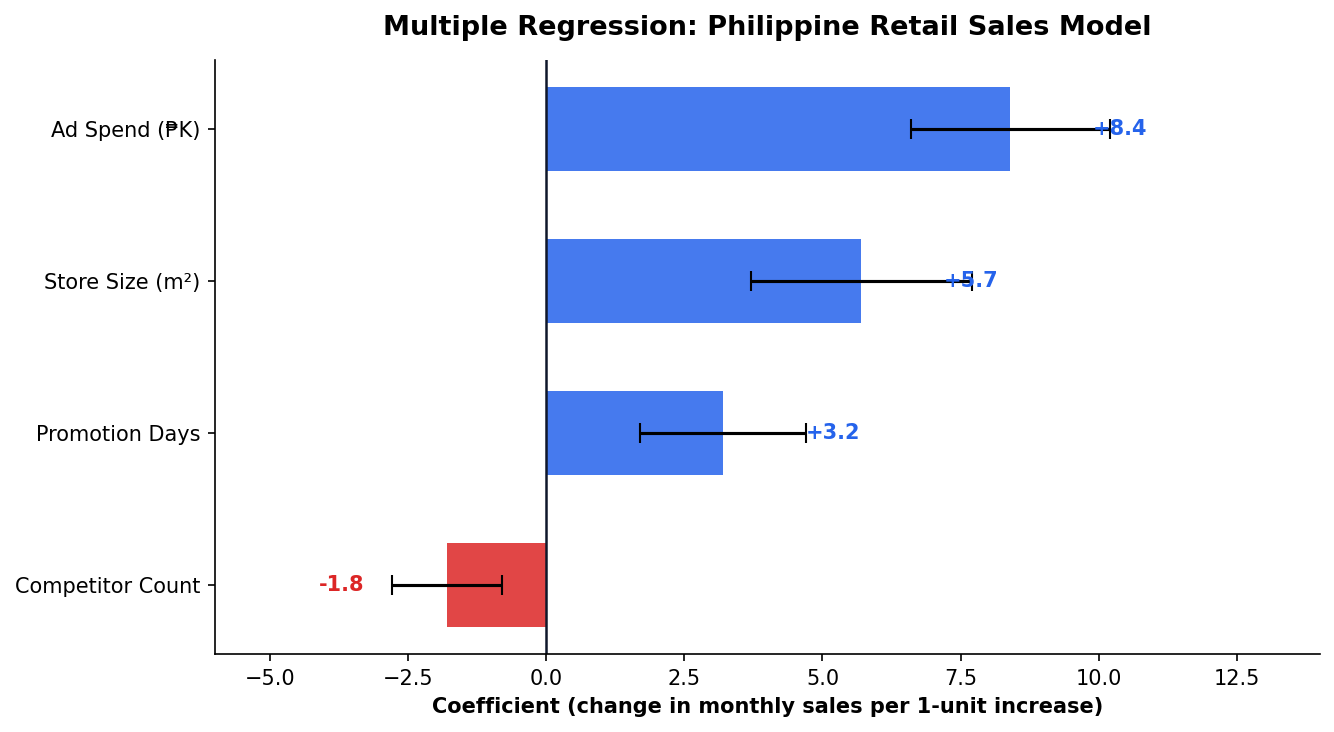
Each bar shows how much monthly sales change per 1-unit increase in that predictor, with 95% confidence intervals.
Holding all else constant — this is what separates regression from simple correlation.
| Predictor | b | Translation |
|---|---|---|
| Ad Spend ₱K | +8.4 | Each additional ₱1K in ads → ₱8.4K more sales |
| Store Size m² | +5.7 | Larger stores sell more, all else equal |
| Promotion Days | +3.2 | Each promo day adds ₱3.2K |
| Competitor Count | −1.8 | Each nearby competitor costs ₱1.8K |
For every 1-unit increase in X, Y changes by b₁ units — holding all other variables constant.
They don’t want coefficients. They want: “Should we spend more on ads or open a bigger store?” Your regression answers this.
A regression is only as good as its assumptions. Visual diagnostics tell you when to trust — and when to stop.
Violated assumptions → biased coefficients, wrong p-values, misleading conclusions.
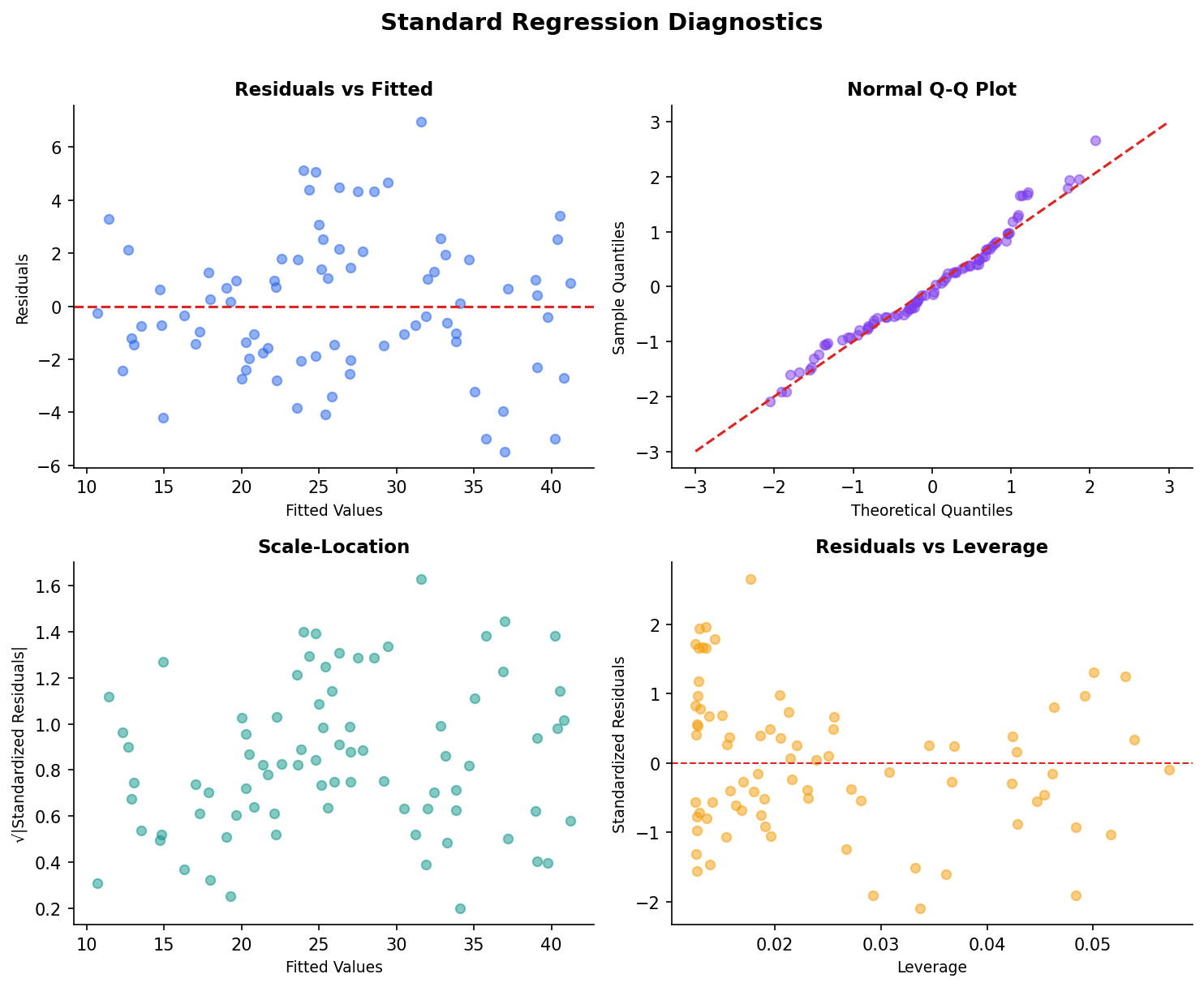
Visual diagnostics catch most violations quickly — no advanced math needed.
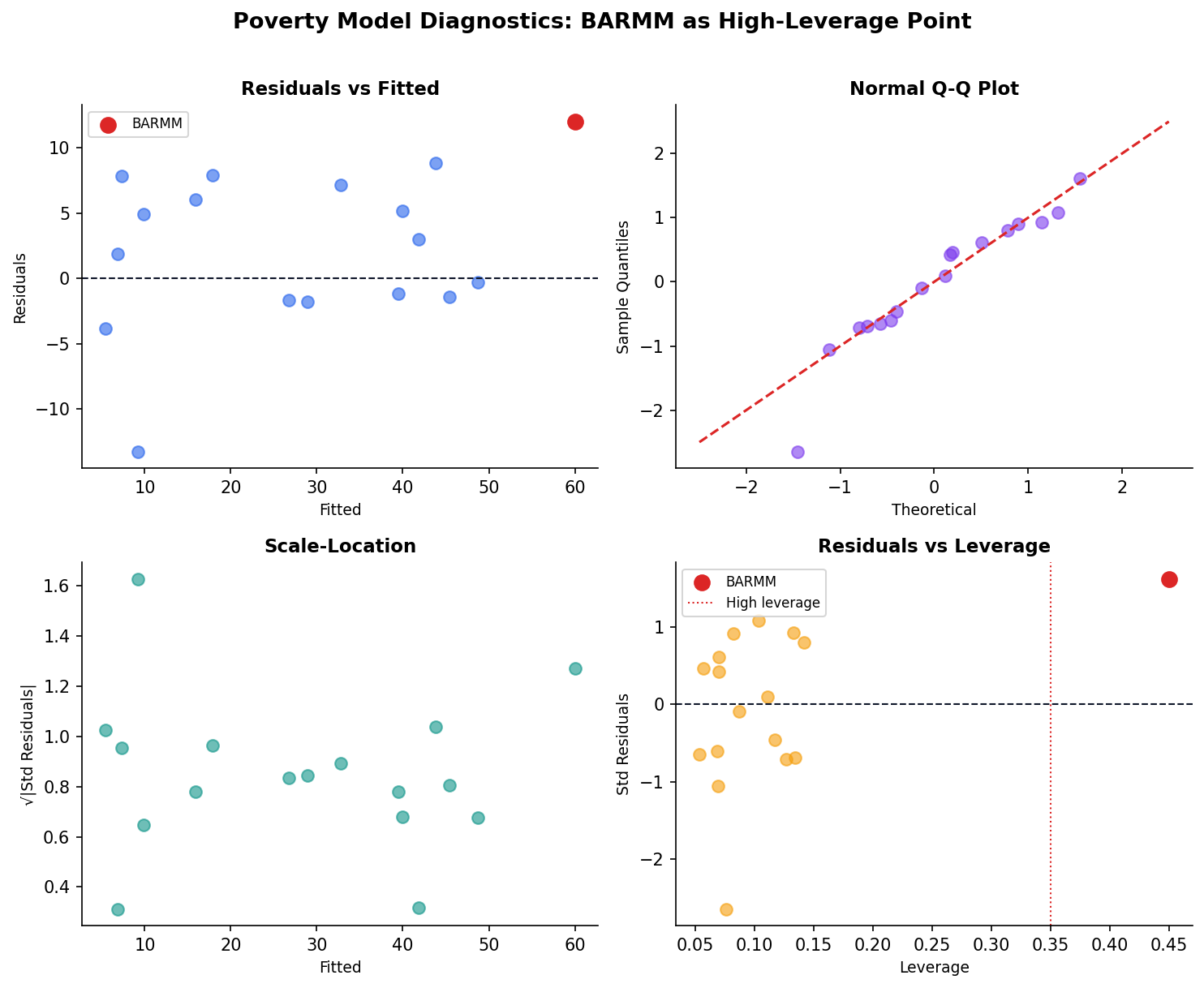
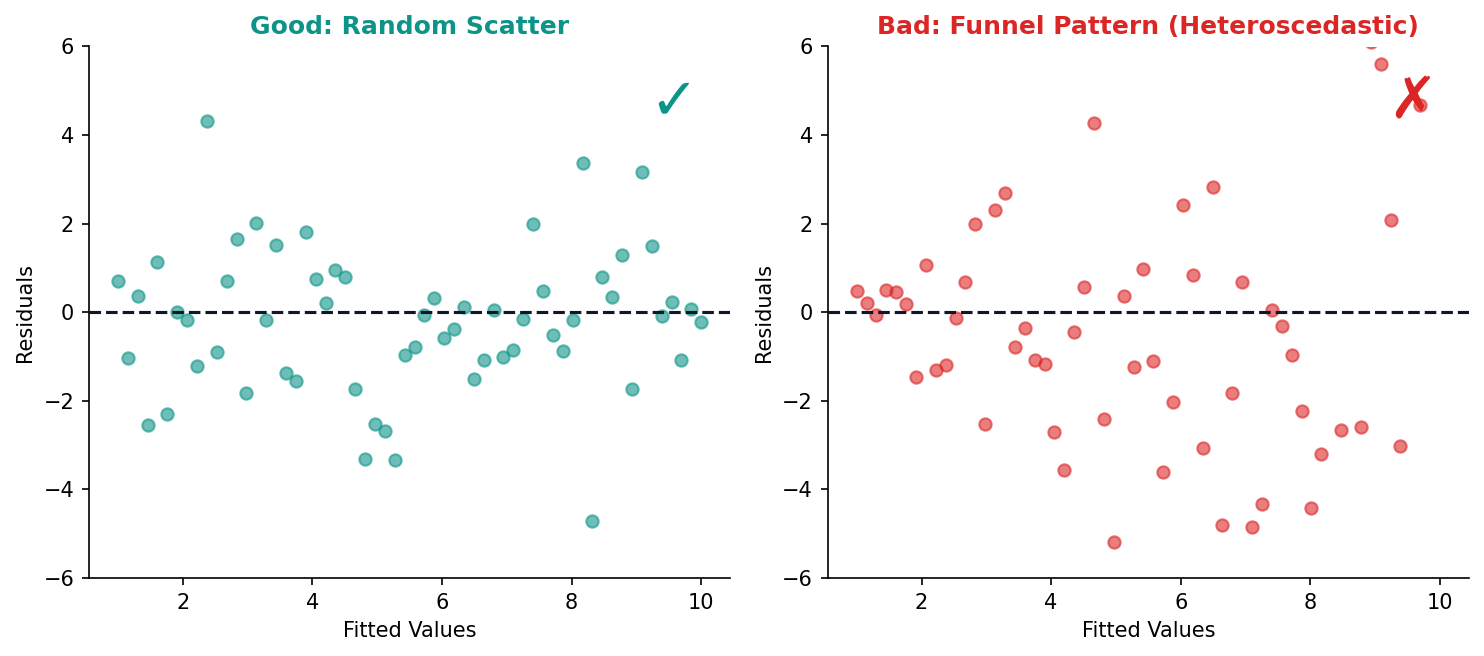
Patterns = problems. Random scatter around zero = the model is working. Any structure means the model is missing something.
Points on the diagonal = normal residuals. Curved tails = heavy-tailed or skewed errors.
The residual plot is your first diagnostic check. Random scatter means the model’s assumptions hold. Patterns reveal specific problems.
Random scatter around zero — assumptions met.
Funnel shape — variance increases with x (heteroscedasticity). Fix: log-transform y or use robust standard errors.
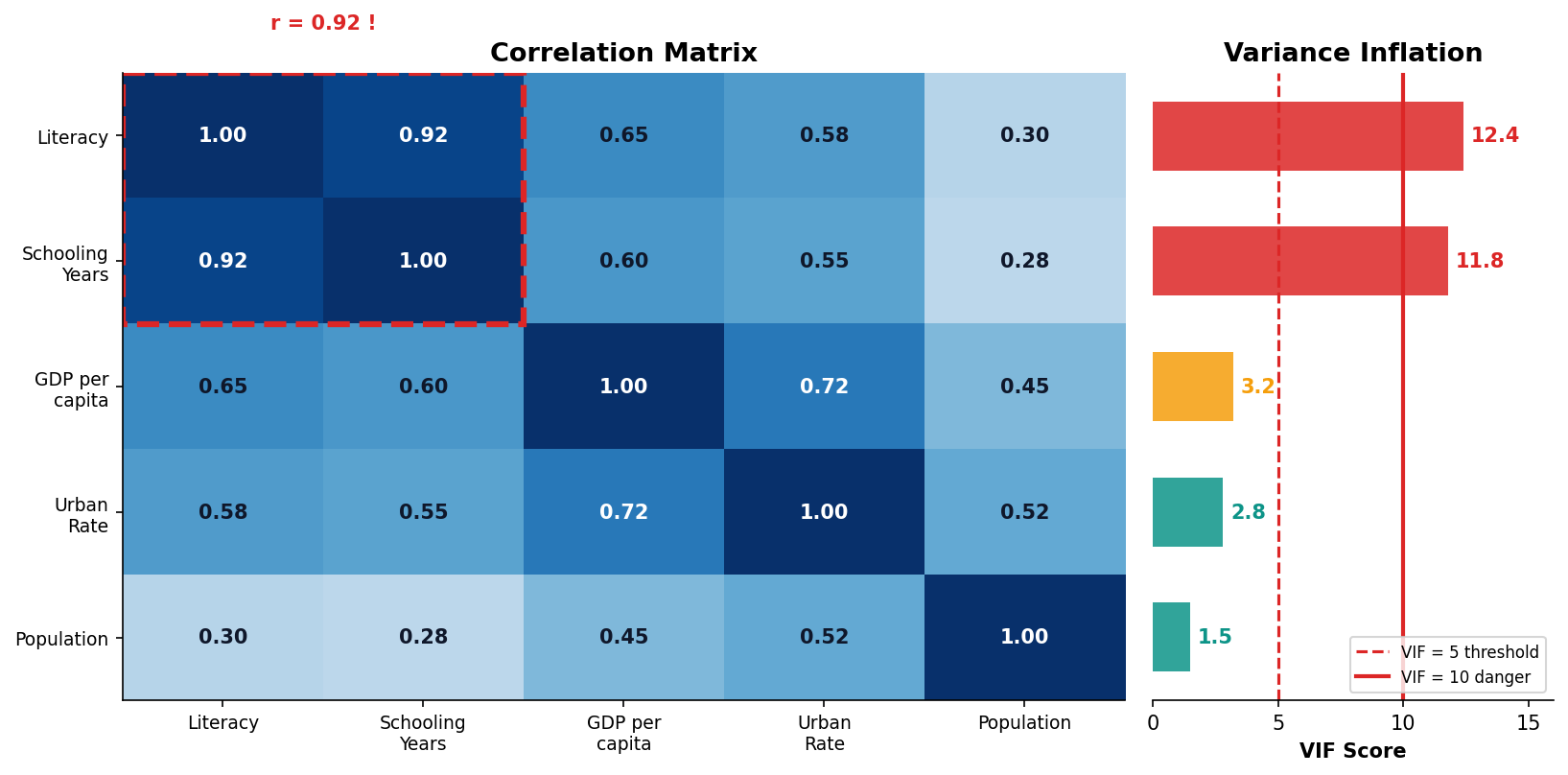
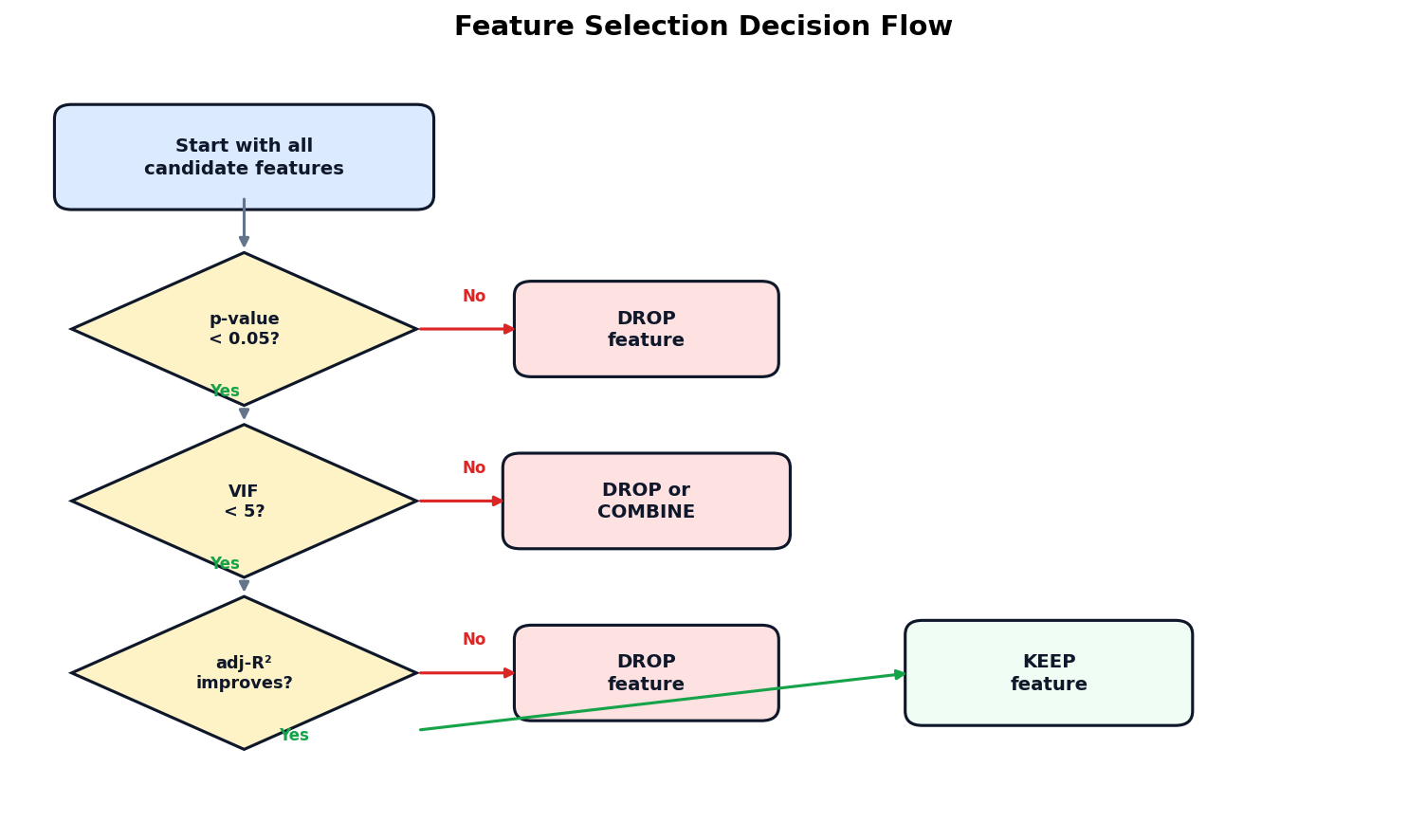
VIF > 5 → investigate. VIF > 10 → drop one of the correlated variables or combine them into a single index.
Literacy rate and years of schooling have r = 0.92 (VIF > 12). Using both in the same model makes neither coefficient reliable.
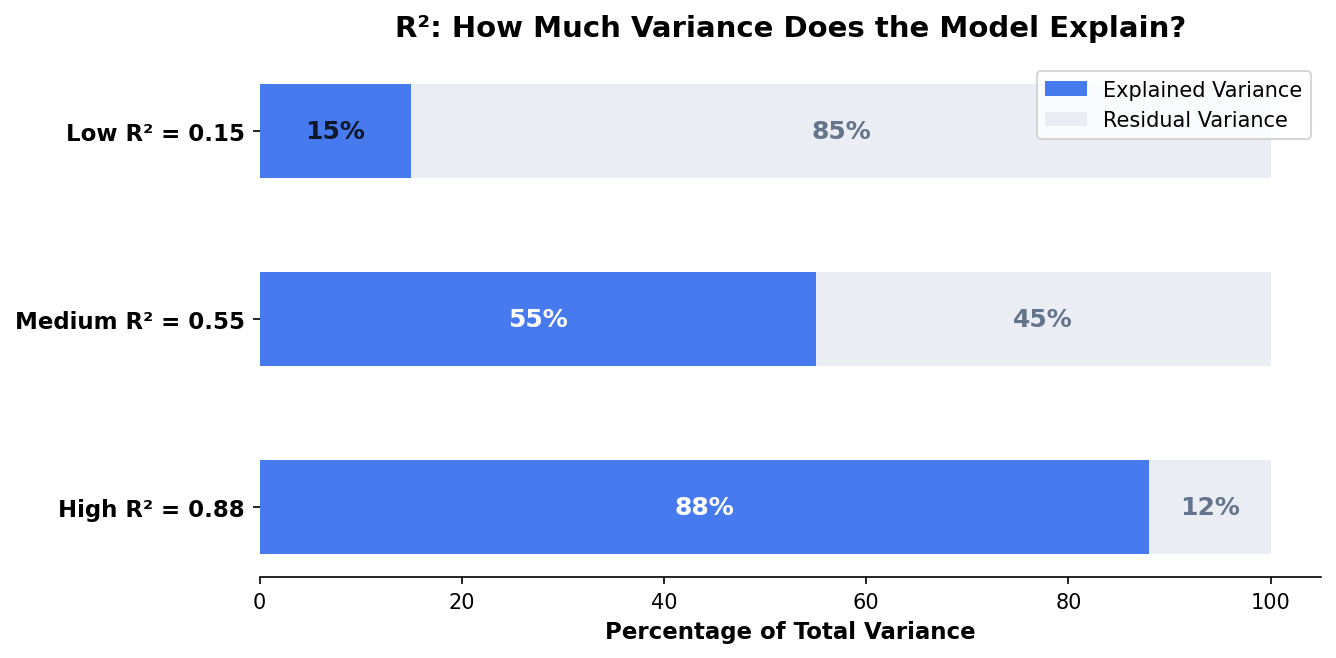
R² tells you how much you explained. RMSE tells you how far off you are. Context tells you if the model is useful.
R² = 0.30 may be excellent in social science where human behavior is noisy. R² = 0.95 in physics is expected. Always compare to domain baselines.
Penalizes adding useless variables. If adjusted R² drops when you add a feature, that feature is noise — remove it.
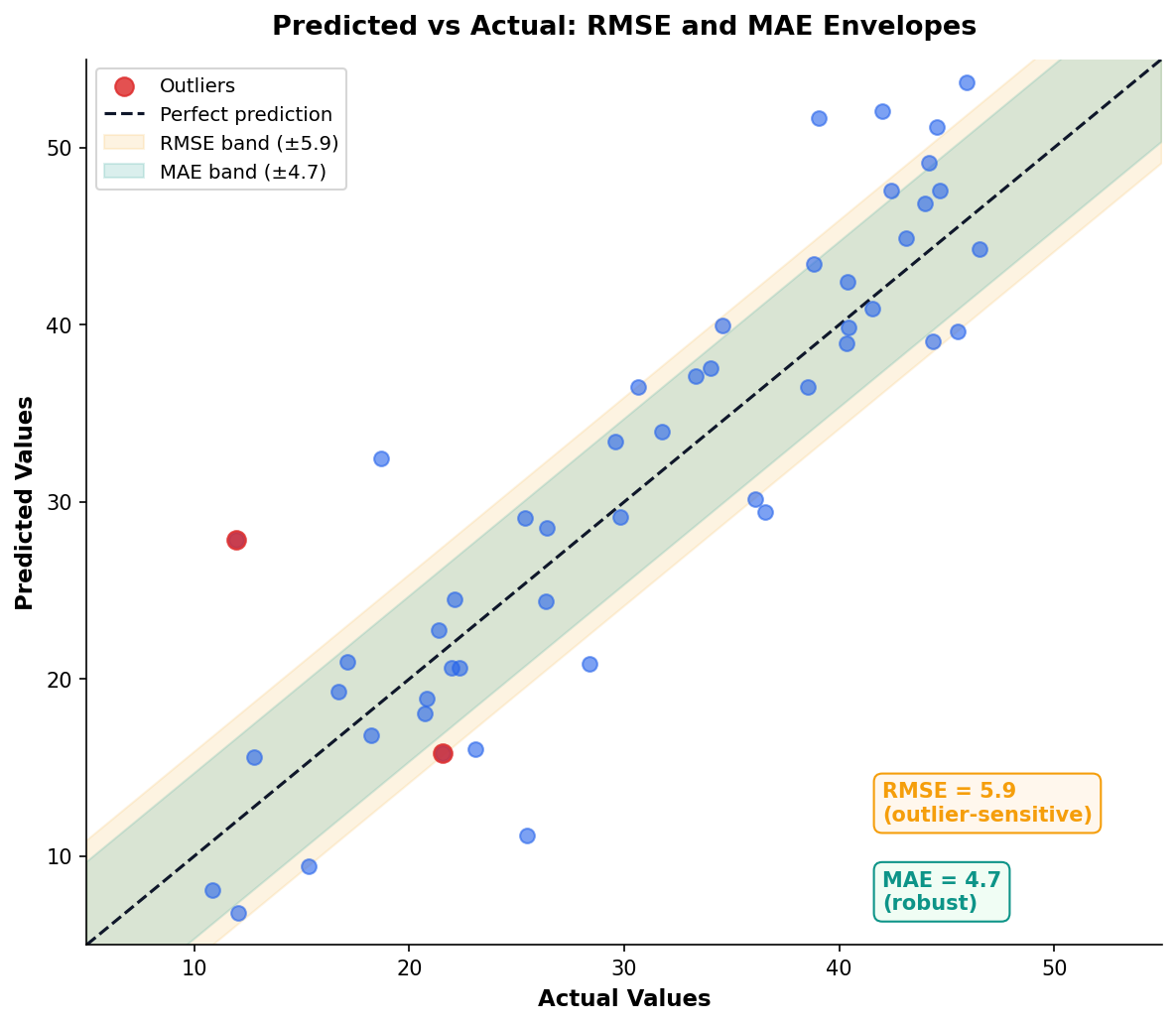
Both measure prediction error in the same units as your outcome variable. RMSE penalizes large errors more heavily; MAE treats all errors equally.
| Metric | Strength | Weakness |
|---|---|---|
| RMSE | Sensitive to outliers | Penalizes big misses |
| MAE | Robust to outliers | Ignores error magnitude |
Report both. If RMSE >> MAE, you have outlier predictions that need investigation.
Automated stepwise selection can overfit — it optimizes p-values, not real-world relevance. Always start with domain knowledge.
If dropping a variable barely changes adjusted R², drop it. Simpler models are easier to explain to stakeholders.
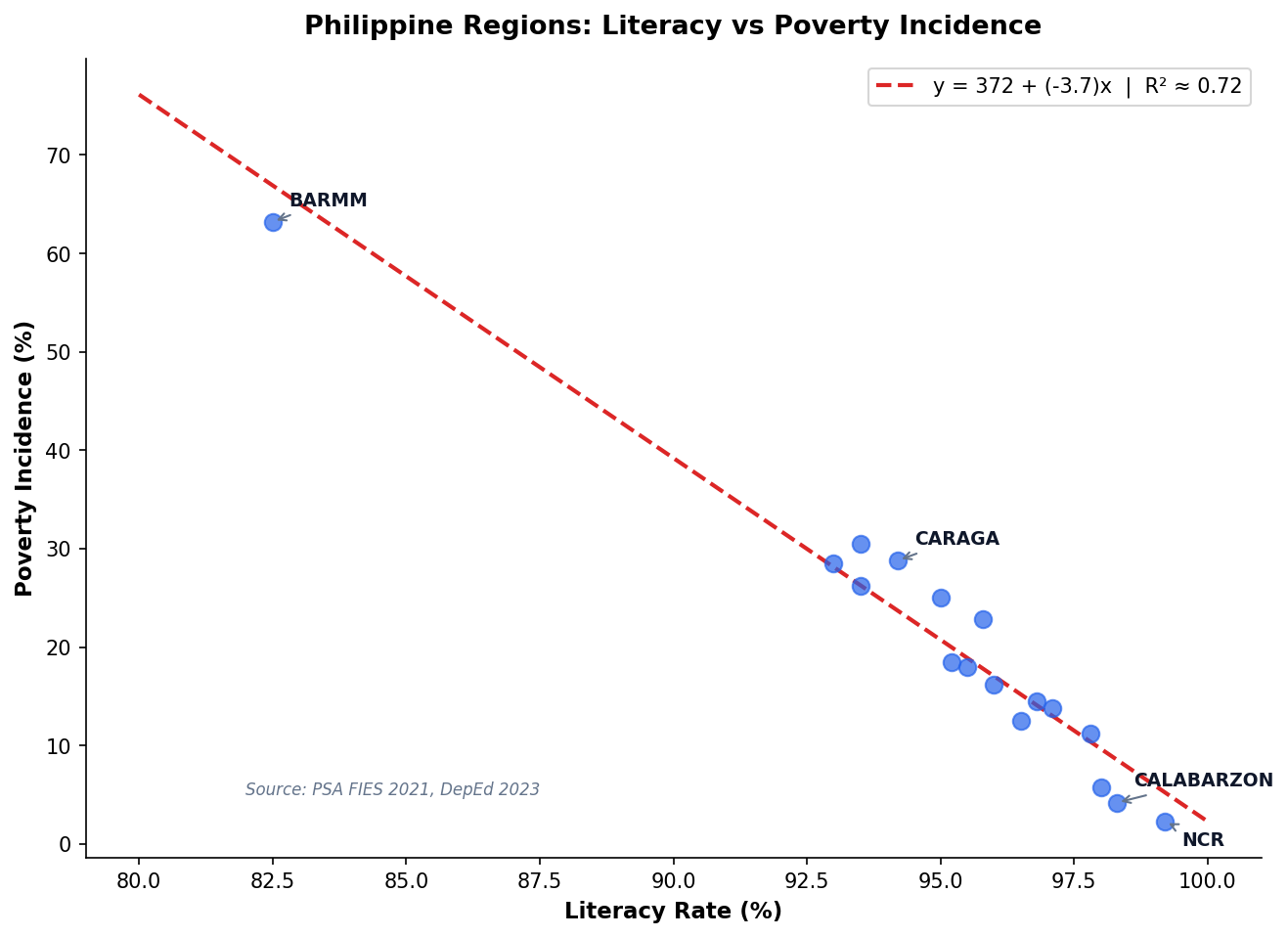
PSA Family Income and Expenditure Survey 2021, DepEd Regional Statistics 2023. N = 17 regions.
Every 1 percentage-point increase in literacy is associated with a 2.8 pp decrease in poverty incidence (R² ≈ 0.72).
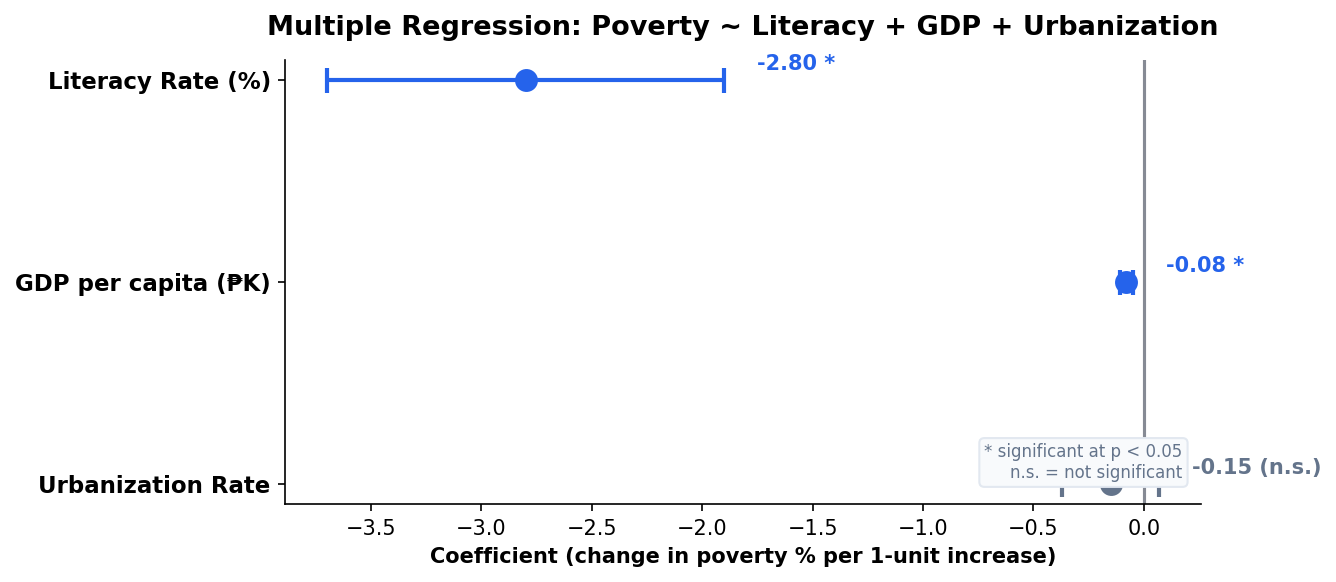
Adding GDP per capita and urbanization rate to the literacy model:
| Predictor | Coeff. | Note |
|---|---|---|
| Literacy Rate | −2.80* | Strongest predictor |
| GDP per capita | −0.08* | Significant but small effect |
| Urbanization | −0.15 | Not significant after controlling for GDP |
Urbanization becomes non-significant once GDP is in the model — suggesting urbanization’s effect on poverty operates through economic output, not independently.
Generally clean residuals for 15 of 17 regions. BARMM appears as a high-leverage point — its poverty rate (63%) is a structural outlier driven by conflict, not just economic factors.
Model is reasonable for most regions. BARMM and NCR are structural outliers — report them separately rather than letting them distort the model.
Too many predictors for your sample size. Rule of thumb: need 10–15 observations per predictor. With 17 Philippine regions, limit to 2–3 predictors.
"I added 8 predictors to a 17-row dataset and got R² = 0.99!"
The model predicts well within the data range. Outside it, predictions are meaningless. Don’t predict poverty for a region with 70% literacy if your data only goes down to 82%.
"Our model says poverty would be −5% if literacy reached 100%."
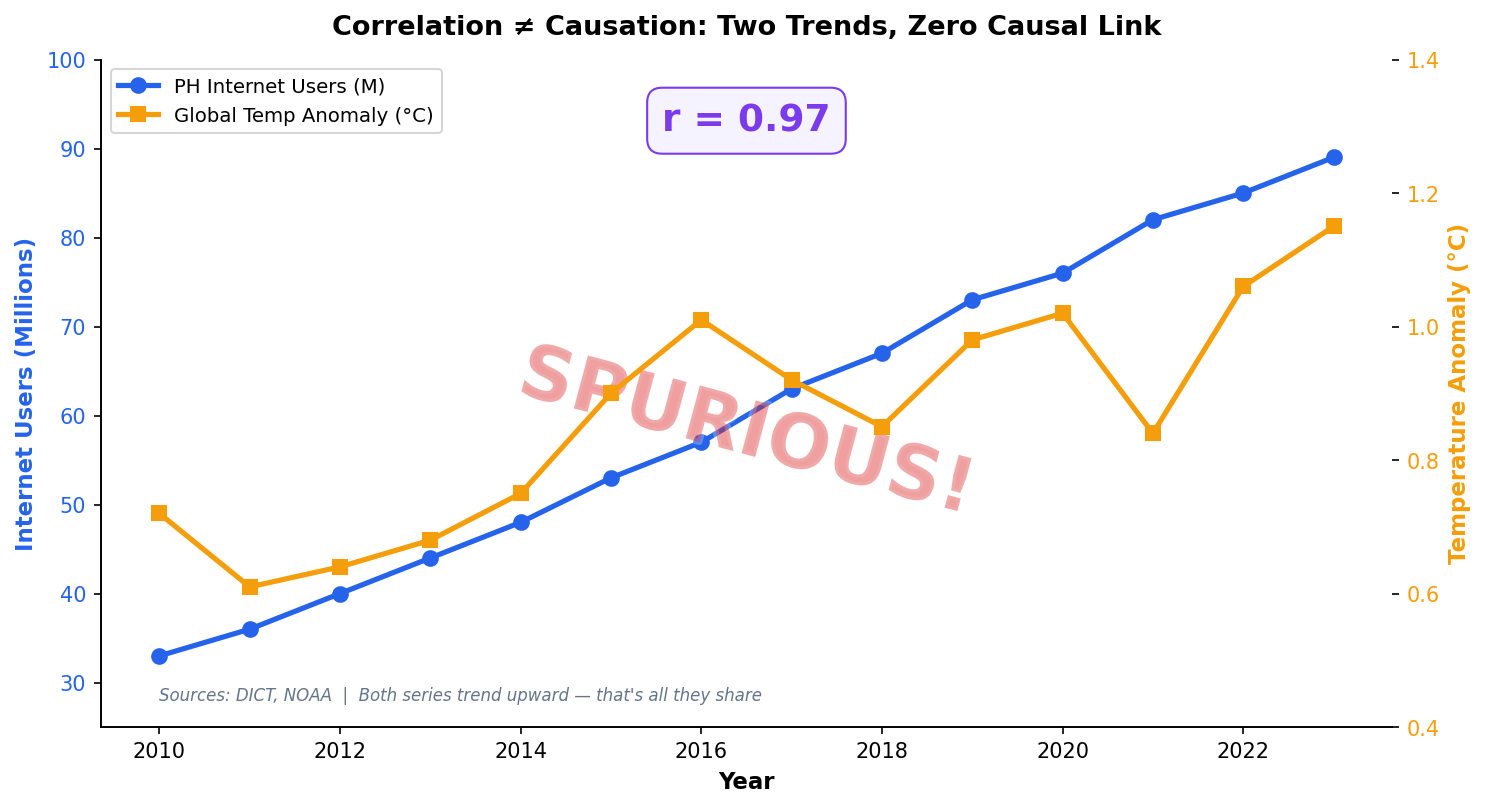
Regression coefficients show association, not causation. Ice cream sales and drowning both rise in summer — regression would show a “significant” relationship.
"The data proves that ice cream causes drowning."
All three pitfalls share a root cause: forgetting the limitations of the model and over-interpreting the output.
Always state what the model cannot tell you alongside what it can. This builds credibility with stakeholders.
A regression coefficient tells you that X and Y move together after controlling for other variables. It does not tell you that X causes Y.
Randomized controlled trials, natural experiments, or instrumental variables. Observational regression alone — no matter how high the R² — cannot prove causation.
Always use language like “associated with” or “predicts,” never “causes” or “leads to,” when reporting regression results from observational data.
Next: Session 2 — Logistic Regression & Classification
From probabilities to decisions
Department of Computer Science
University of the Philippines Cebu
"Behind every automated approval is a probability and a threshold."
Behind every decision is a logistic regression model trained on borrower features.
2M
decisions/month
0.5 sec
per decision
₱0
human review for standard cases
The sigmoid function, log-odds, and how to interpret odds ratios for stakeholders.
Confusion matrix, precision, recall, F1, and ROC-AUC — and when each matters most.
Threshold tuning, cost-benefit analysis, and Philippine case studies in credit and education.
By the end of this session you will be able to build, evaluate, and explain a classification model for binary outcomes.
Builds on: Session 1 Linear Regression
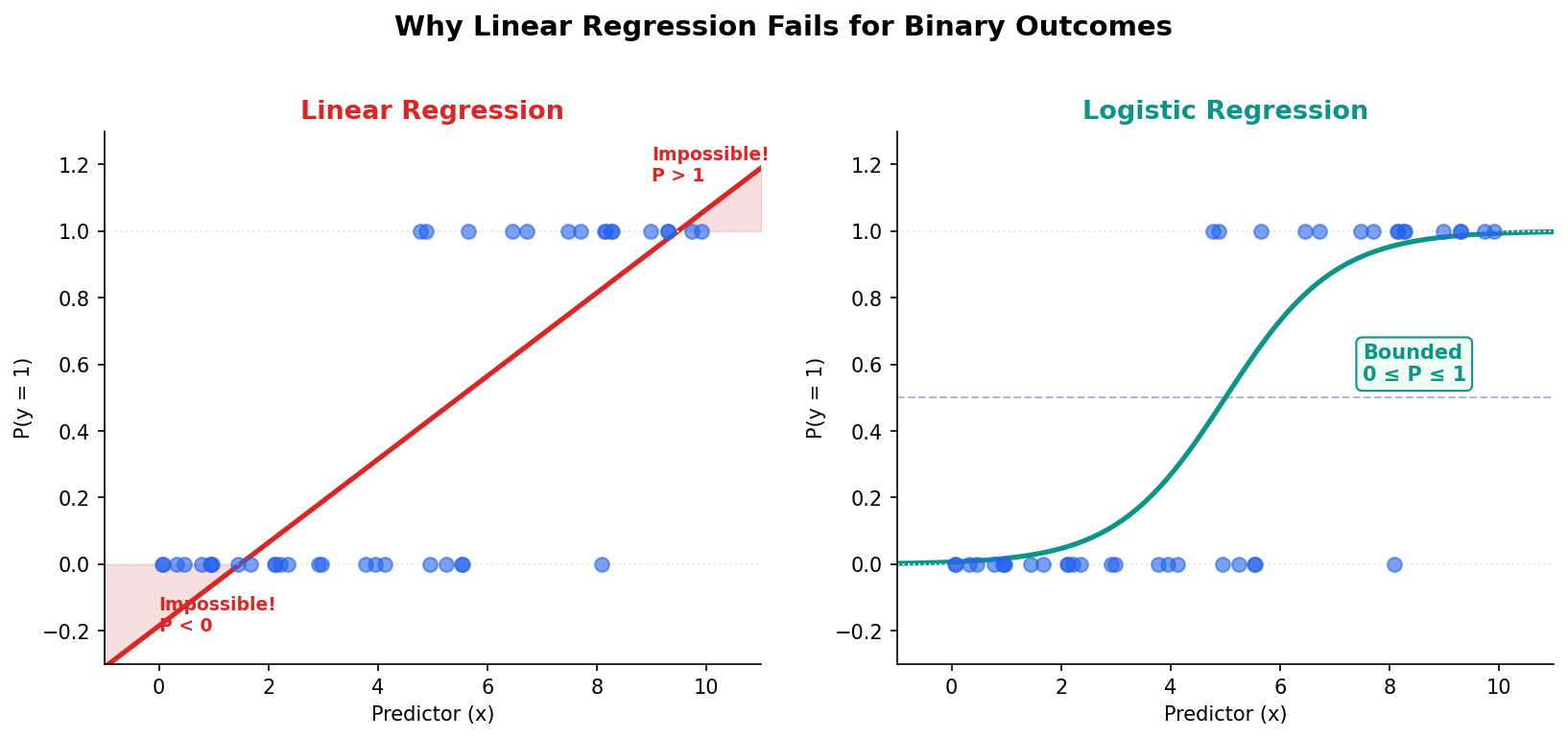
When the outcome is yes or no, linear regression breaks. The sigmoid function fixes it — and odds ratios make it interpretable.
Linear regression predicts −0.2 or 1.3 for a probability — mathematically impossible. The prediction is unbounded.
Wrap the linear prediction in a sigmoid function. Output is always between 0 and 1 — a valid probability.
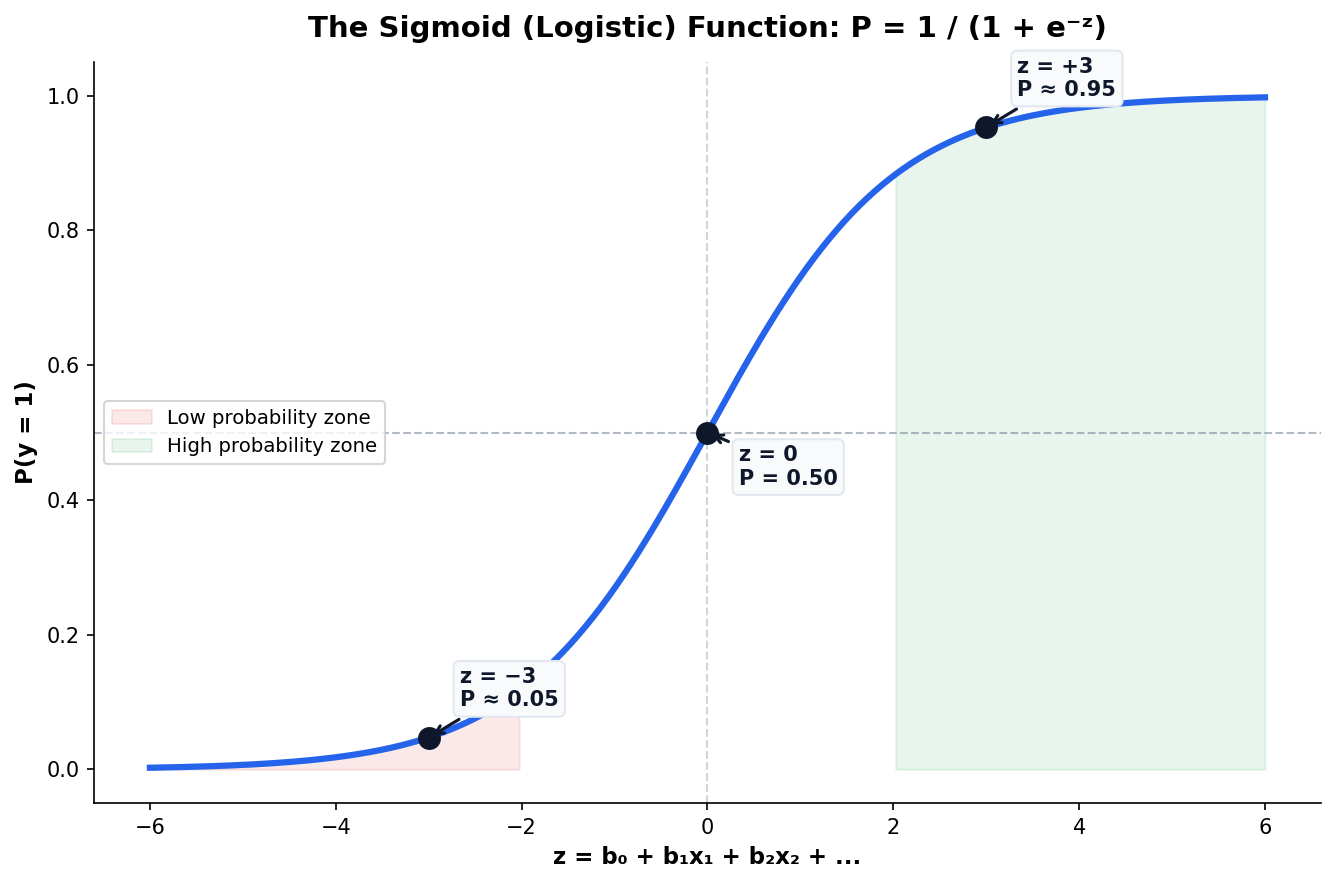
The logistic function transforms any real-valued score z into a probability P between 0 and 1. The S-shape ensures smooth transitions near the decision boundary.
Natural for binary outcomes: as evidence increases, probability approaches 1 asymptotically but never exceeds it.
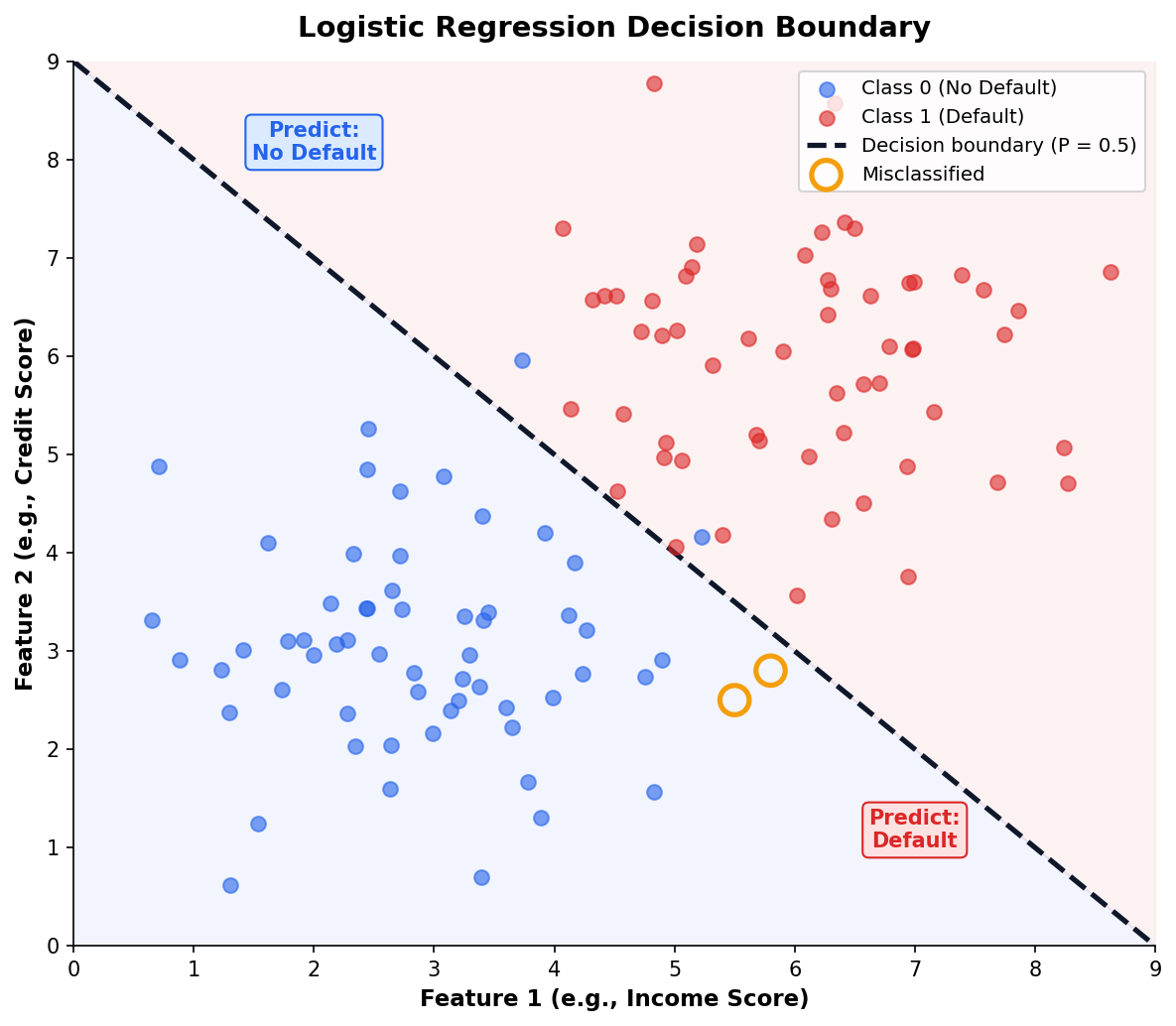
Where P crosses 0.5 is the default classification threshold — but it’s rarely the optimal one for real problems.
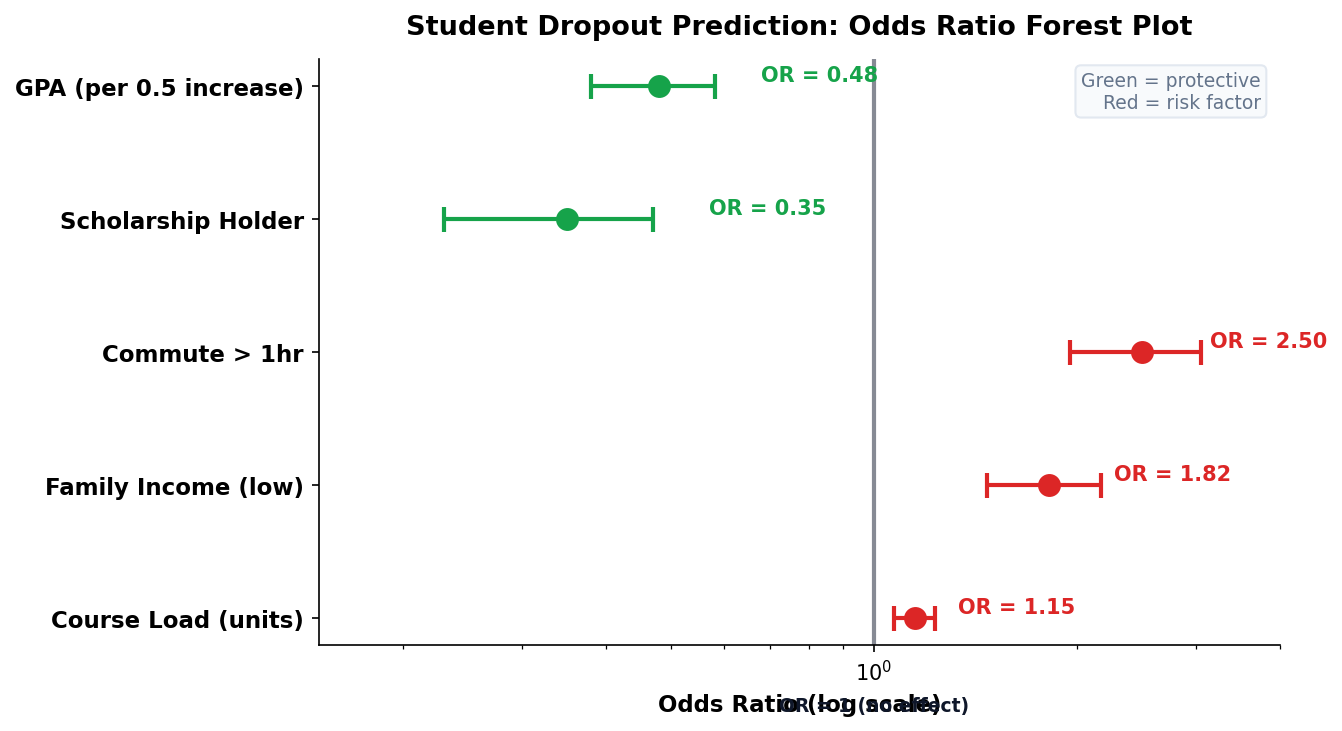
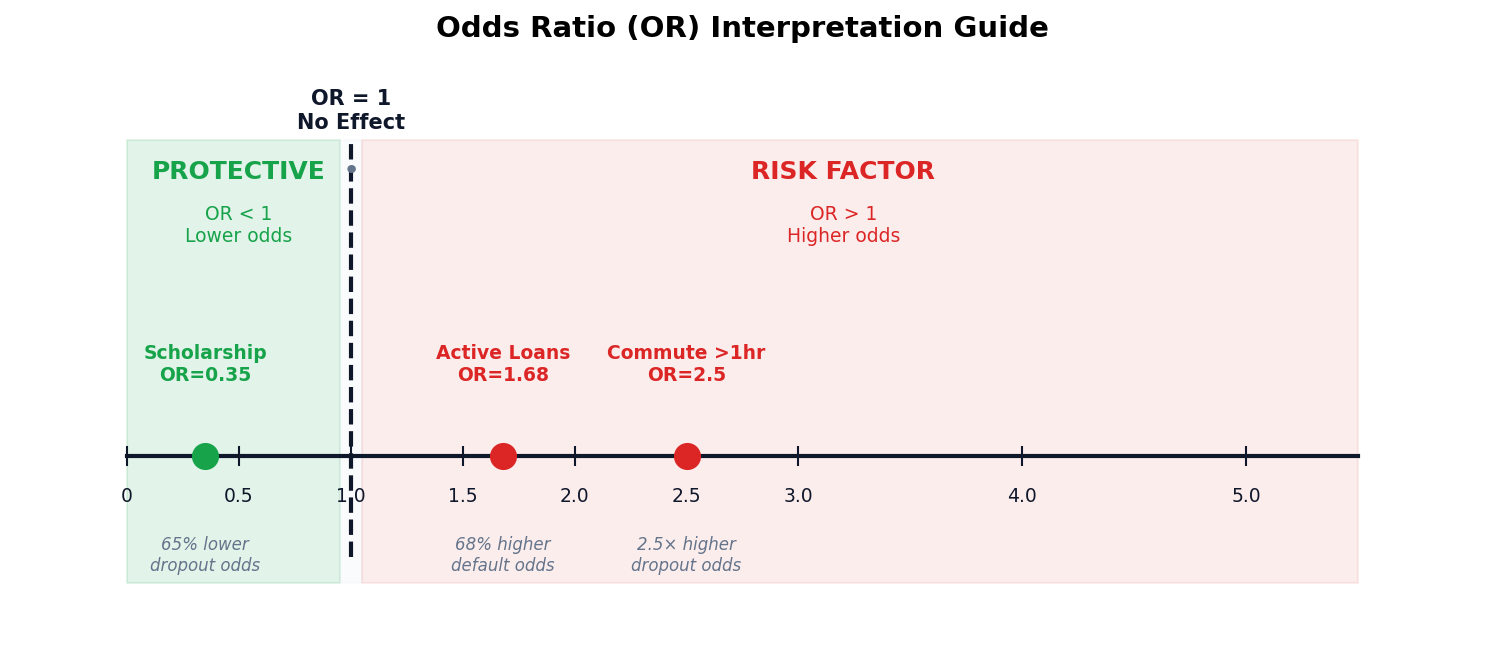
In logistic regression, we exponentiate the coefficient (e𝗛) to get the odds ratio. This tells stakeholders how much the odds change per unit increase in the predictor.
OR = 1: no effect. OR > 1: increases odds. OR < 1: decreases odds. OR = 2.5 means the odds are 2.5× higher for a 1-unit increase.
A scholarship holder has OR = 0.35 for dropout — meaning 65% lower odds of dropping out compared to non-scholarship students.
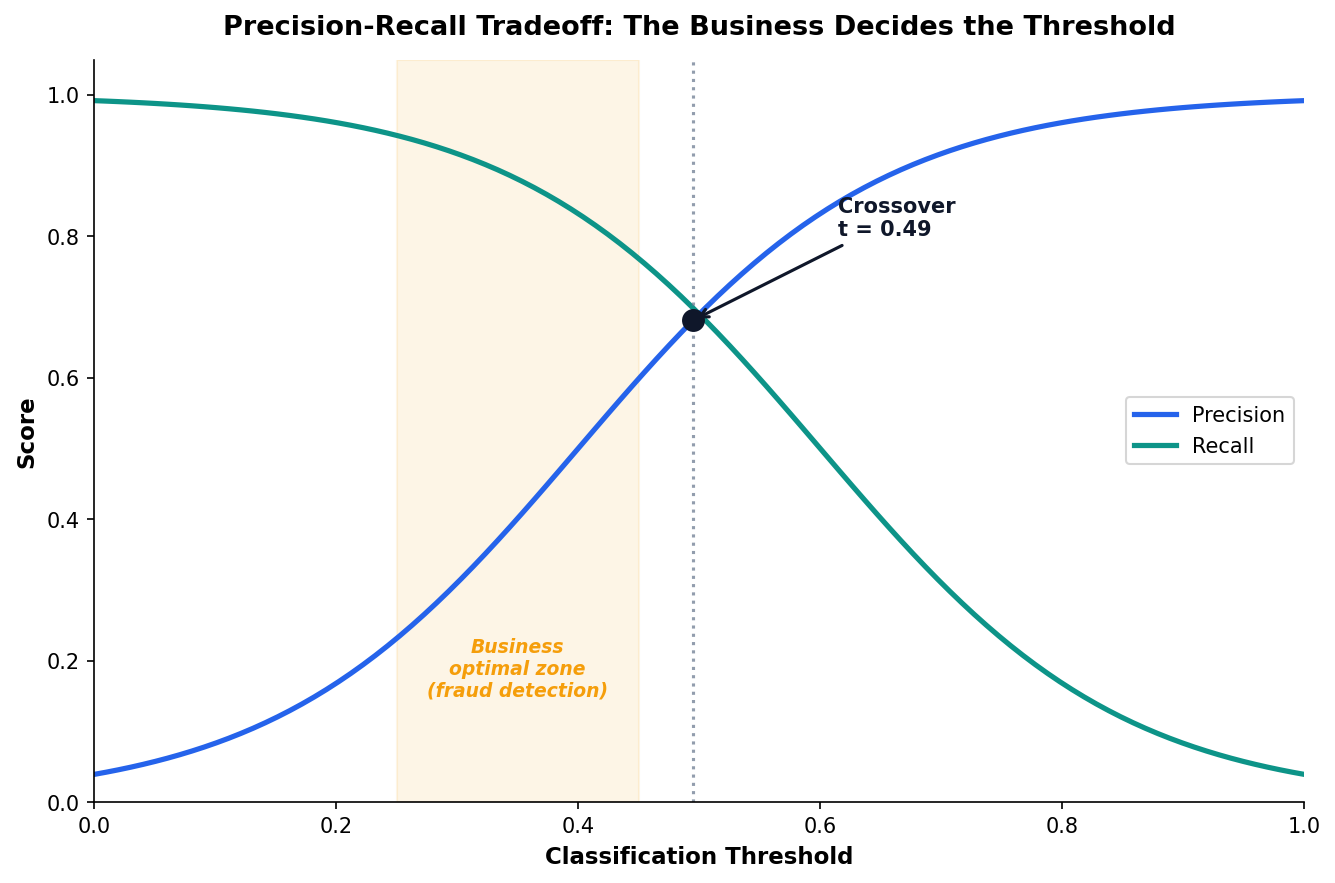
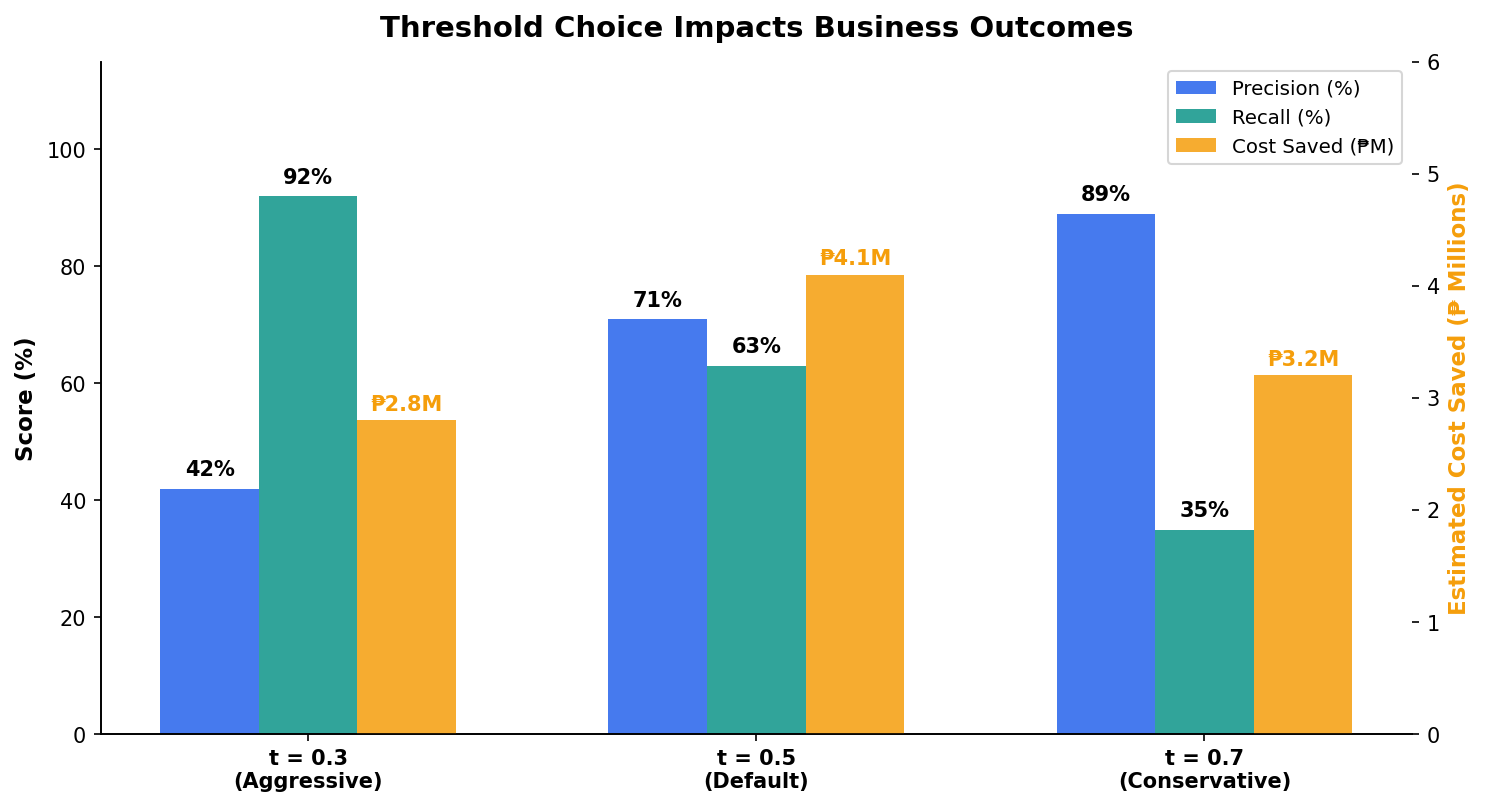
But it’s rarely optimal. If false negatives are costly (missing fraud, missing disease), lower the threshold to catch more positives.
Lowering the threshold catches more true positives but also more false positives. The business context determines the right balance.
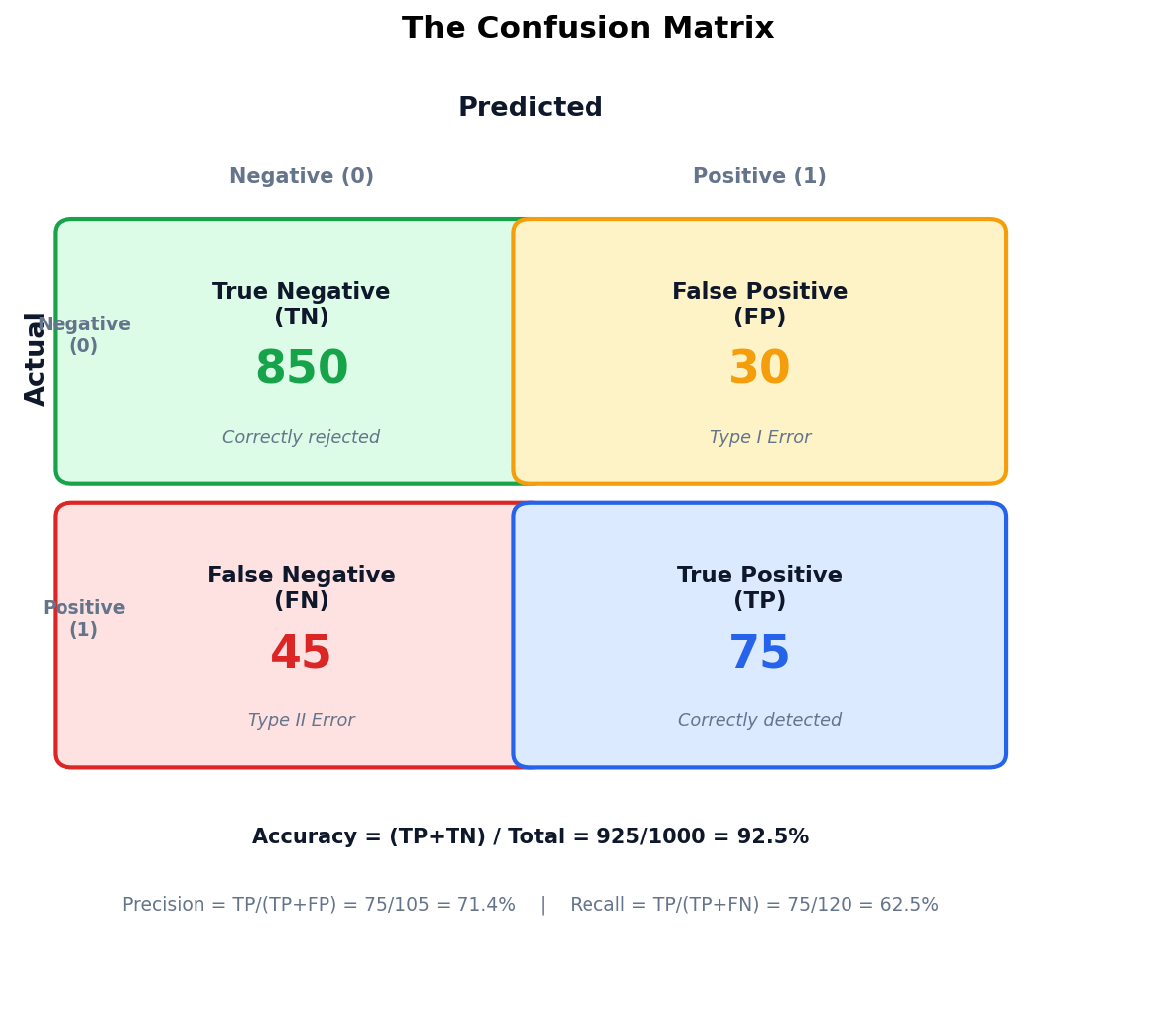
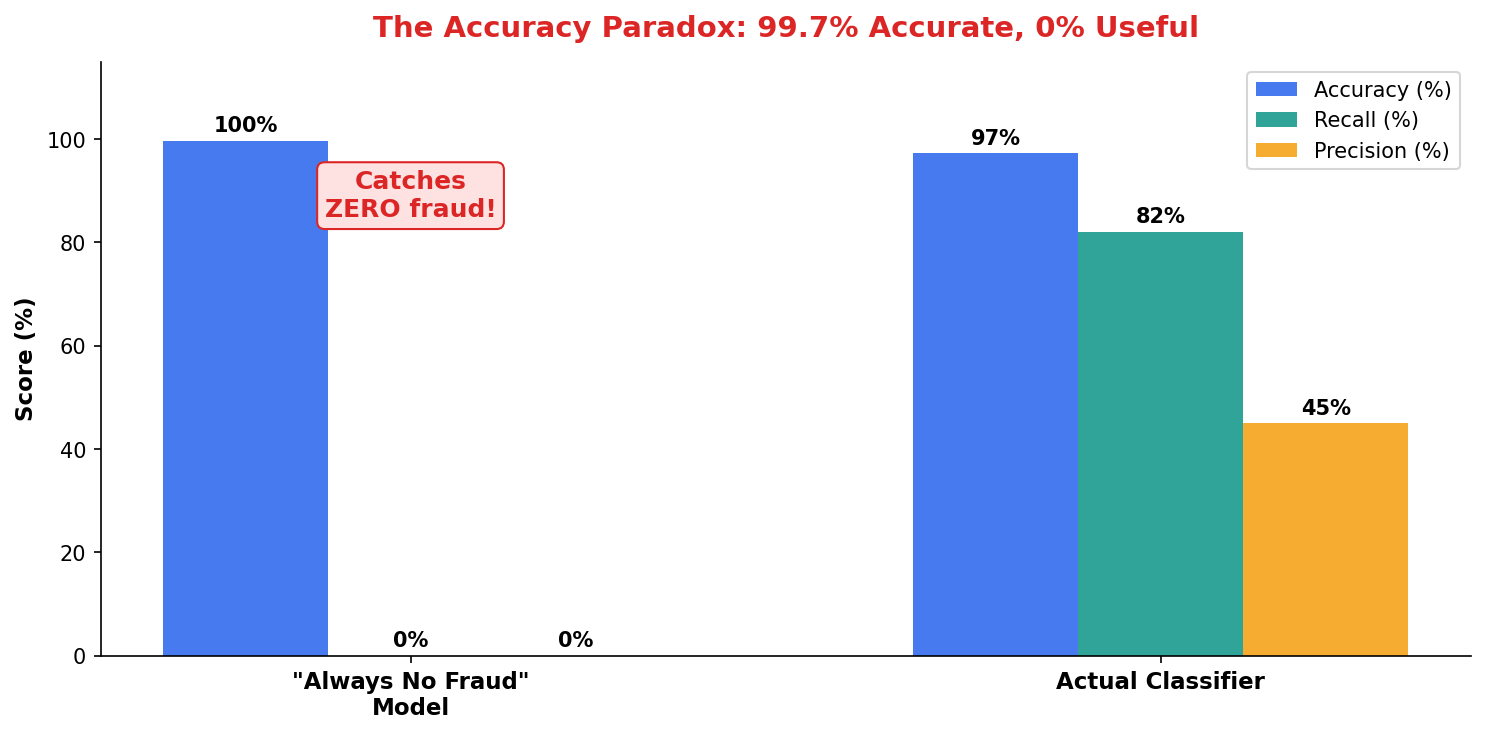
Accuracy is a lie in imbalanced data. Precision, recall, and AUC tell the real story.
Flagging a good borrower as default risk — costs the lender a customer and reputation.
Missing an actual default — the costly one. The lender loses the principal.
A model that predicts “no fraud” for every transaction achieves 99.7% accuracy — but catches zero fraud. Useless.
BSP reports credit card fraud at ~0.3% of transactions. Any accuracy metric above 99% is meaningless without checking recall.
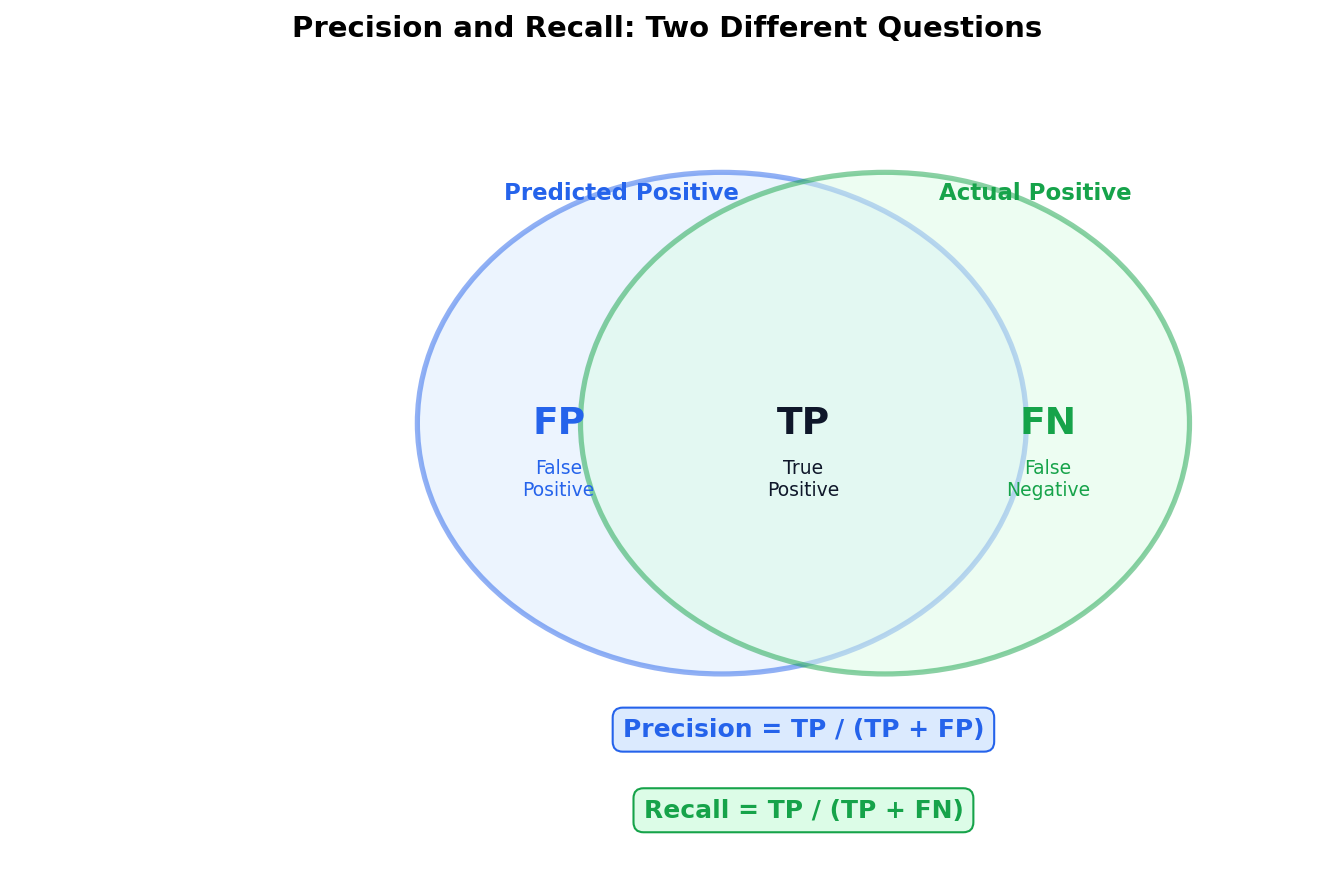
Precision asks: “Of everything I flagged, how much was correct?” Recall asks: “Of everything that was positive, how much did I catch?”
Spam filter — don’t block legitimate email. Cost of FP > cost of FN.
Disease screening — don’t miss sick patients. Cost of FN > cost of FP.
Harmonic mean of precision and recall. Use when you need to balance both and can’t afford to optimize one at the expense of the other.
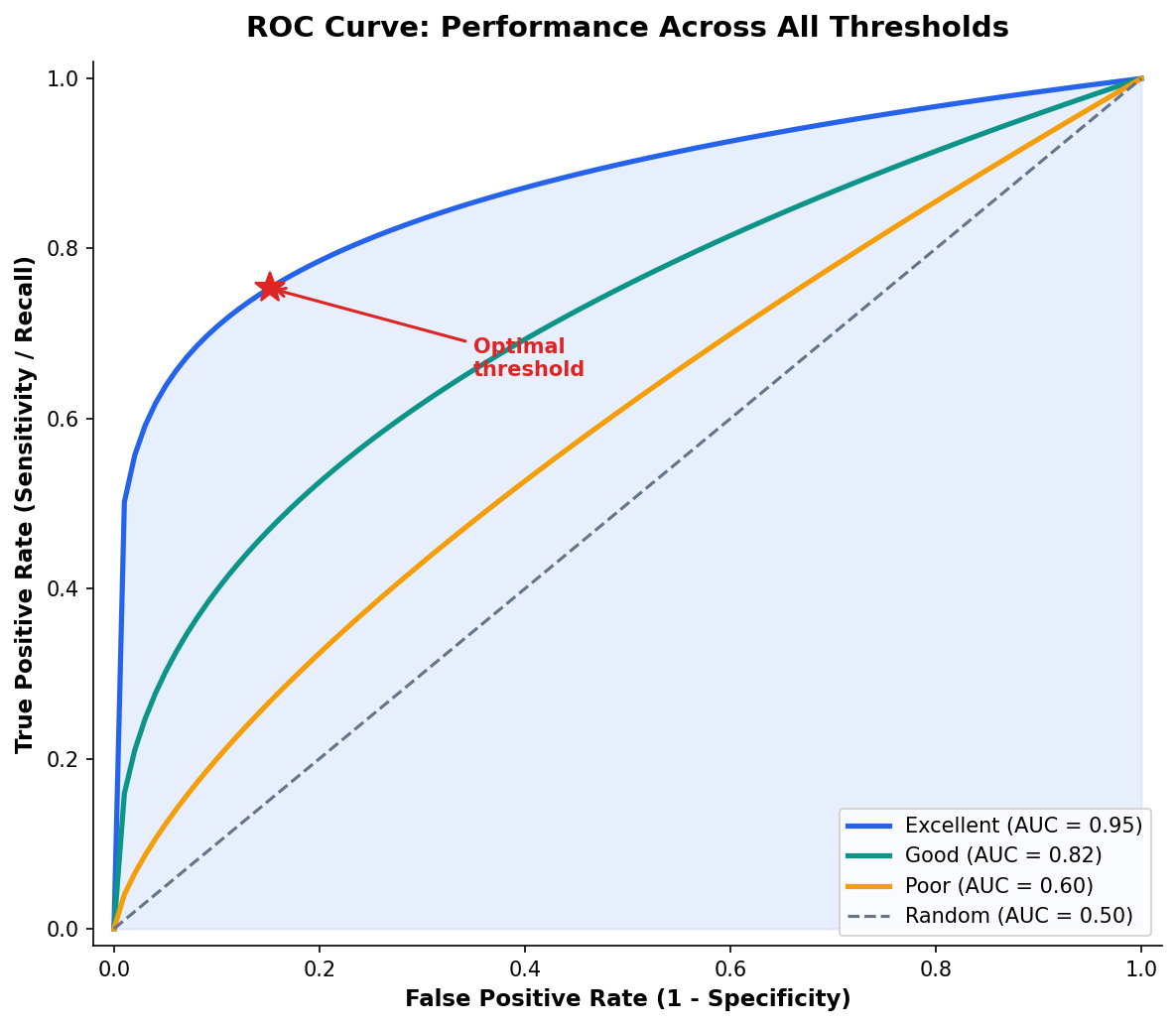
0.5 = coin flip. 0.7–0.8 = fair. 0.8–0.9 = good. 0.9+ = excellent. Always compare to a baseline model, not to perfection.
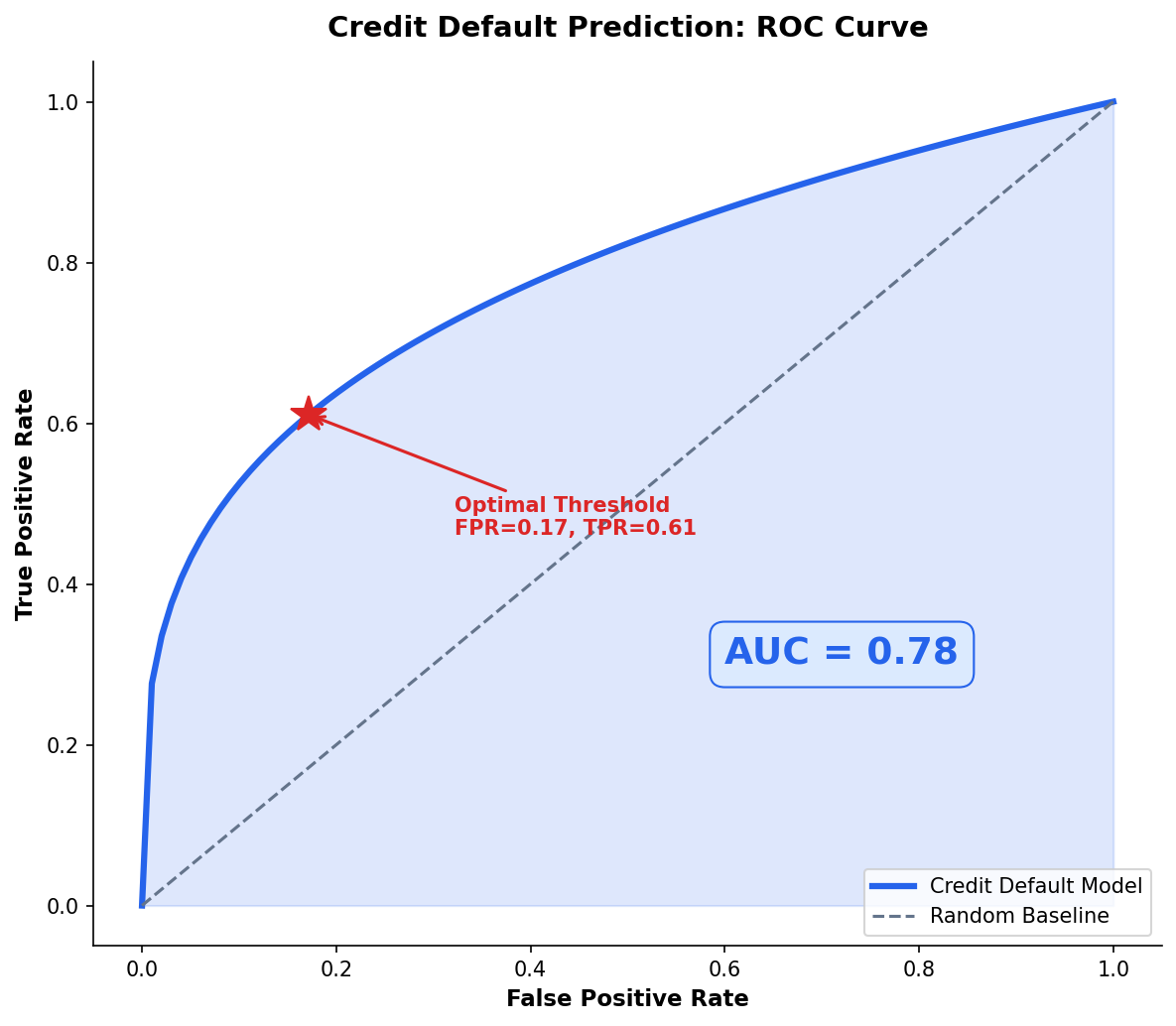
ROC for balanced datasets. Precision-Recall curve for imbalanced data — it won’t hide poor performance on the minority class.
The optimal threshold depends on the relative cost of false positives vs false negatives. This is a business decision, not a statistical one.
For student loan defaults, missing a default costs ₱50K+. Over-flagging costs a phone call. Set the threshold lower to maximize recall.
From credit scoring to student retention — logistic regression powers decisions across Philippine institutions.
Simulated based on CHED enrollment statistics and UP System retention rates. N = 2,000 students.
Scholarship holders have 65% lower dropout odds. Every 30-min commute increase raises odds by 40%. GPA is the single strongest predictor.
BSP-regulated consumer lending (GCash GLoan, Bayad Center) requires explainable models per BSP Circular 855.
| Feature | OR | Interpretation |
|---|---|---|
| Monthly Income | 0.62 | Higher income → lower default odds |
| Outstanding Balance | 1.45 | Higher balance → higher risk |
| Employment Length | 0.78 | Longer tenure → lower risk |
| Active Loans | 1.68 | More loans → 68% higher default odds |
BSP requires that lending models be explainable to regulators and consumers. Logistic regression’s odds ratios satisfy this requirement directly.
The analyst’s job: translate OR = 1.68 into “every additional active loan increases default risk by 68%.”
Low risk (P < 0.3): auto-approve. Medium (0.3–0.7): manual review. High (P > 0.7): auto-reject. Thresholds set by business, not by data science.
A stakeholder-ready table mapping model output to business actions — not a confusion matrix.
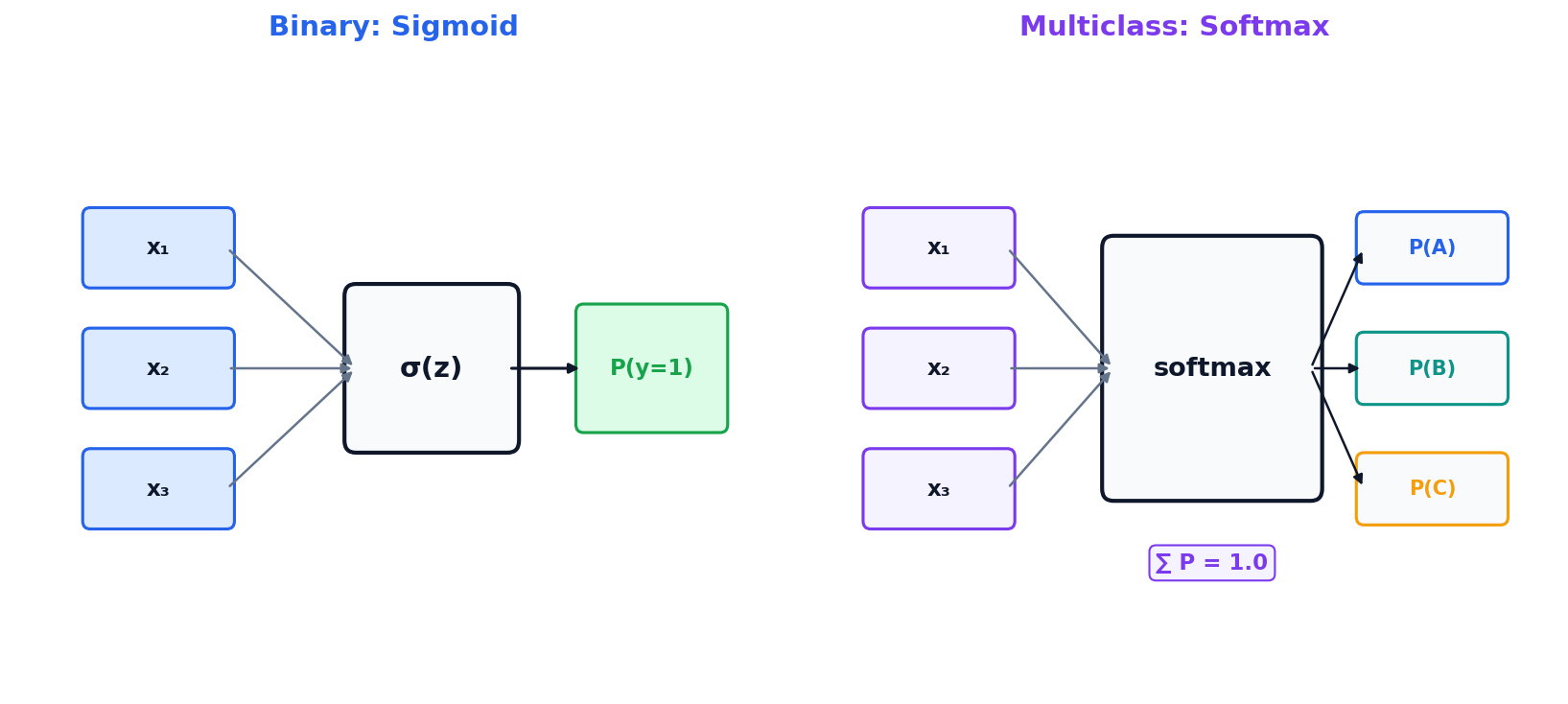
When the outcome has more than two categories (e.g., customer segment A/B/C), the sigmoid extends to softmax — one probability per class, summing to 1.
If you have 3+ classes, use softmax. For most analytics use cases, binary logistic regression covers the majority of decision problems.
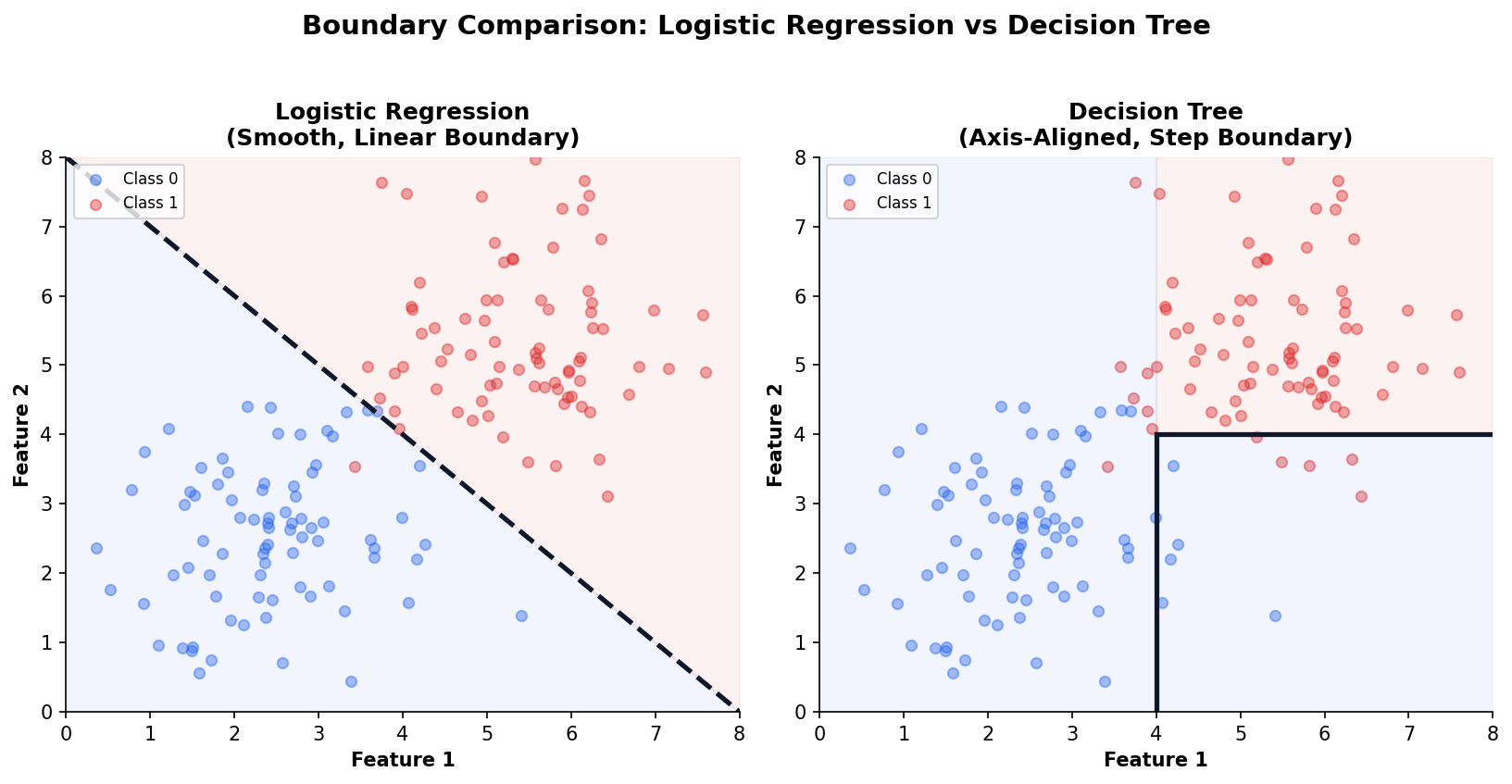
Decision trees handle multiclass naturally and don’t require the linearity assumption. Next week we explore when trees beat regression.
Both can classify. The choice depends on your data and your audience.
| Criterion | Logistic Regression | Decision Tree |
|---|---|---|
| Interpretability | Coefficients + OR | If-then rules |
| Feature Types | Numeric (needs encoding) | Numeric + categorical natively |
| Linearity | Assumes linear log-odds | No linearity assumption |
| Interactions | Must add manually | Discovers automatically |
| Speed | Very fast | Fast (slower for ensembles) |
Next week we explore decision trees, random forests, and gradient boosting — and when they outperform logistic regression.
Always check class balance first. If 99% of cases are negative, accuracy is useless. Use F1, AUC, or precision-recall instead.
"Our fraud model has 99.7% accuracy!" — it predicts “no fraud” for everything.
OR = 0.5 means protective (50% lower odds), not harmful. Misreading direction leads to exactly wrong recommendations.
"OR = 0.35, so scholarships increase dropout risk!" — it’s the opposite.
Different business contexts require different thresholds. Fraud detection (low threshold) ≠ churn prediction (balanced) ≠ medical screening (very low).
"We use 0.5 for everything." — one size never fits all.
Each mistake leads to actionable harm: wrong metrics mislead leadership, wrong direction inverts policy, and wrong thresholds cost money.
Always: (1) check class balance, (2) verify OR direction with domain logic, (3) tune threshold to business cost structure.
Next Week: Tree-Based Methods — Decision Trees, Random Forests, and Gradient Boosting
Tree-Based Methods
Decision Trees — interpretable if-then rules
Random Forests — ensemble power
Gradient Boosting — state-of-the-art tabular performance
Lab 7: Build a Philippine credit scoring model, interpret odds ratios, and optimize the threshold for a business objective.